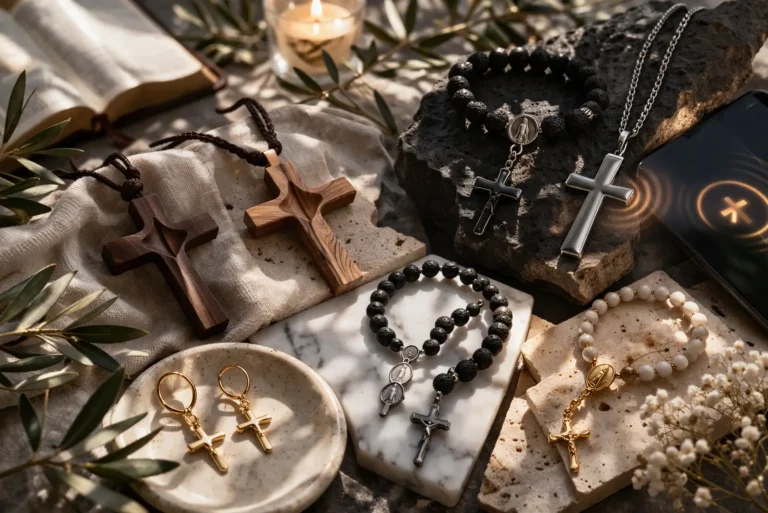


A Straightforward Guide to Symbols, Materials, and Respect “Can a $ 20 cross be blessed in church?”
“Are cheap Buddhist prayer beads just plastic?”
“Is it disrespectful to wear an affordable ring with Quranic script?”
These are real questions we receive every day at ReligionRosary.com.
They come from students, young professionals, parents buying gifts, or new believers—people who aren’t looking for museum-quality relics, but simply want an affordable piece they can wear daily without worry, error, or unintended offense.
Today, let’s talk honestly:
Price doesn’t determine respect—choices do.
Even budget-friendly religious jewelry can be worn with peace of mind, as long as it meets three basic standards.
Standard #1: Symbols Must Be Correct — Accuracy Costs Almost Nothing
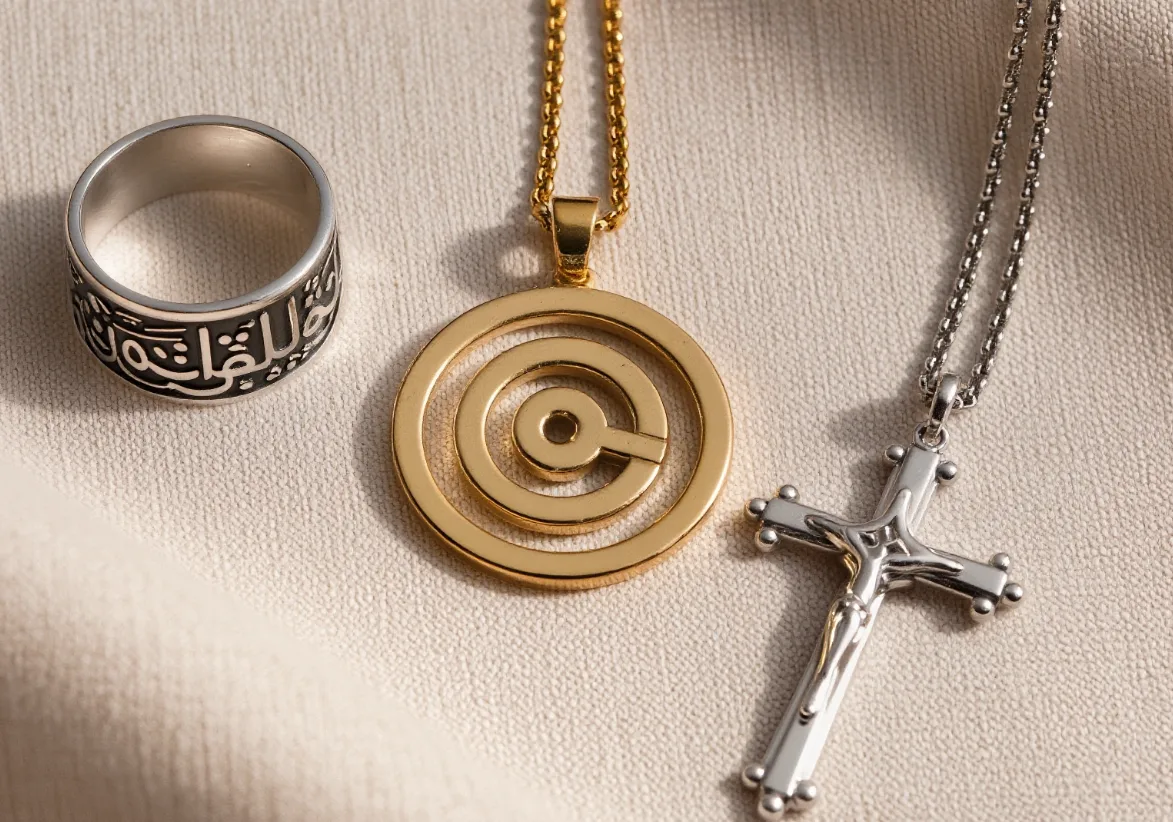
You don’t need expensive craftsmanship to get symbols right. But getting them wrong—even unintentionally—can cause real discomfort or offense.
- The Buddhist swastika (卍) must be right-facing, as used for centuries across Asia to symbolize auspiciousness. The left-facing version (卐) carries heavy historical baggage in the West and is avoided in traditional contexts. We never use it.
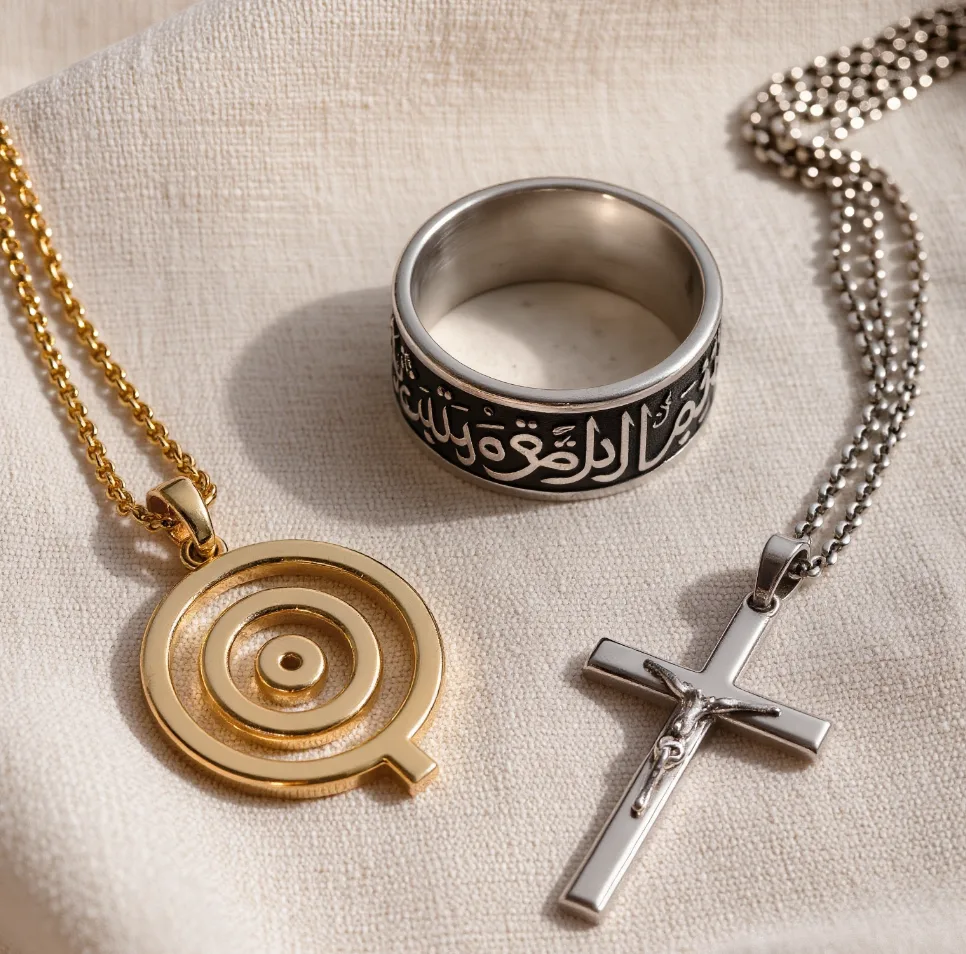
- Islamic “Bismillah” (بسم الله) must be written right-to-left in proper Arabic script—and never wrapped fully around a ring, which would break the sacred phrase. This is a widely accepted guideline in mainstream Islamic scholarship.
- Christian crosses are clearly labeled: “empty cross” (common in Protestant traditions) vs. “crucifix with corpus” (used in Catholic and Orthodox practice)—so you know exactly what you’re receiving.
These details add negligible cost—but they show care.
For us, skipping them to save a few cents isn’t worth losing your trust.
Standard #2: Materials Should Be Honest — Not “Magical,” Just Safe
Let’s be clear: our $ 25 rosary isn’t carved from 200-year-old olive wood. And that’s okay—because most people don’t need that. What they do need is honesty about what they’re buying.
Here’s what we commit to:
- Metals: All silver-toned items use nickel-free, lead-free alloy with 925 silver plating—safe for daily skin contact and resistant to quick tarnishing.
- Wood & Seeds: Our “basic” malas use natural rudraksha or bodhi seeds (not dyed plastic). They have subtle grain, slight pores, and may darken gently with wear—signs of authenticity, not defect.
- Stones: Items labeled “black onyx” or “agate” use genuine natural stone slices, not glass or resin.
We won’t claim these pieces have “healing energy” or “ancient blessings.” But we will ensure they’re what they say they are—no fake wood, no misleading photos, no hidden plastics.
Standard #3: Purpose Matters — Daily Wear ≠ Sacramental Use
We always encourage clarity about intended use:
- If you need an item for baptism, confirmation, pilgrimage, or formal blessing, we recommend consulting your local clergy and possibly choosing a higher-grade piece (e.g., solid silver, certified wood).
- But if you simply want a daily reminder of faith, peace, or gratitude—something to wear under your shirt or on your wrist during work or study—our affordable line is designed exactly for that.
Think of it like a simple notebook: it may not be leather-bound or handmade, but if it helps you write your prayers or reflections, it serves its purpose well.
Faith lives in intention—not price tags.
That’s why every product page includes clear notes like:
- “Suitable for everyday personal devotion”
- “Not intended for liturgical use without prior blessing”
- “Remove before swimming or showering”
This isn’t legal fine print—it’s helping you choose wisely.
Why We Focus on “Affordable but Respectful”
Because we’ve been there too.
We’ve stood outside a cathedral, wondering if we could justify spending a week’s groceries on a small cross.
We’ve searched online for a simple mala, only to find items with backwards symbols or suspiciously perfect “wood” that felt like plastic.
So at ReligionRosary.com, our mission is simple:
Make respectful, accurate, and safe religious jewelry accessible to everyone—not just those who can afford luxury.
We don’t sell “energetically charged” crystals.
We don’t claim our items are “hand-blessed by monks.”
We just ensure the basics are right: symbols face the correct way, materials are truthfully described, and guidance is clear.
That’s how ordinary people—like you and us—can wear their faith with quiet confidence.
Frequently Asked Questions (Based on Real Customer Messages)
Q1: If it’s so cheap, is the quality terrible?
A: Low price comes from efficient production and minimal packaging—not cutting corners on core integrity. Our silver-plated items meet basic skin-safety standards; our wooden beads are real seeds, not plastic imitations.
Q2: Can I take your cross to church for blessing?
A: Simple metal or wood crosses (without glue-heavy assembly) can often be blessed by a priest—but always check with your parish first. We mark eligible items with “Blessing-Friendly” where appropriate.
Q3: How do I know if my mala is real or fake?
A: Real bodhi or rudraksha seeds have irregular texture, tiny pores, and a matte finish. Plastic feels smooth, glossy, and unnaturally uniform. We provide high-res zoom photos so you can see the details.
Q4: Is wearing inexpensive religious jewelry disrespectful?
A: Disrespect comes from disregard—not cost. If you wear it with sincerity, even a modest piece honors your faith. But wearing sacred symbols as fashion statements (e.g., at parties or clubs) may send the wrong message—regardless of price.
Q5: How are you different from random Amazon or eBay sellers?
A: Many generic sellers use incorrect symbols, unverified materials, and zero religious context. We double-check every design against mainstream tradition, label materials honestly, and offer support if you’re unsure.
Final Thought: Faith Doesn’t Require Luxury—Just Sincerity
In a world of fast fashion and disposable trends, the real act of reverence is this:
Choosing to treat even a small, simple object with mindful respect.
At ReligionRosary.com, we believe:
A 22crosswiththerightsymbol,safematerials,andhonestlabeling﹥ismorefaithfulthana22crosswiththerightsymbol,safematerials,andhonestlabeling﹥ismorefaithfulthana 200 one filled with errors and exaggeration.
Come explore pieces made not for display—but for daily life, quiet prayer, and genuine belief.
All information in this article reflects widely accepted religious norms and basic material safety standards. ReligionRosary.com does not offer “energy charging,” “monk blessings,” or other unverifiable services. We promise only this: accurate symbols, truthful materials, and clear descriptions.
🔗 Discover affordable, respectful religious jewelry for everyday wear: https://www.religionrosary.com