
Where Ancient Sky-Watching Meets Modern Spiritual Jewelry
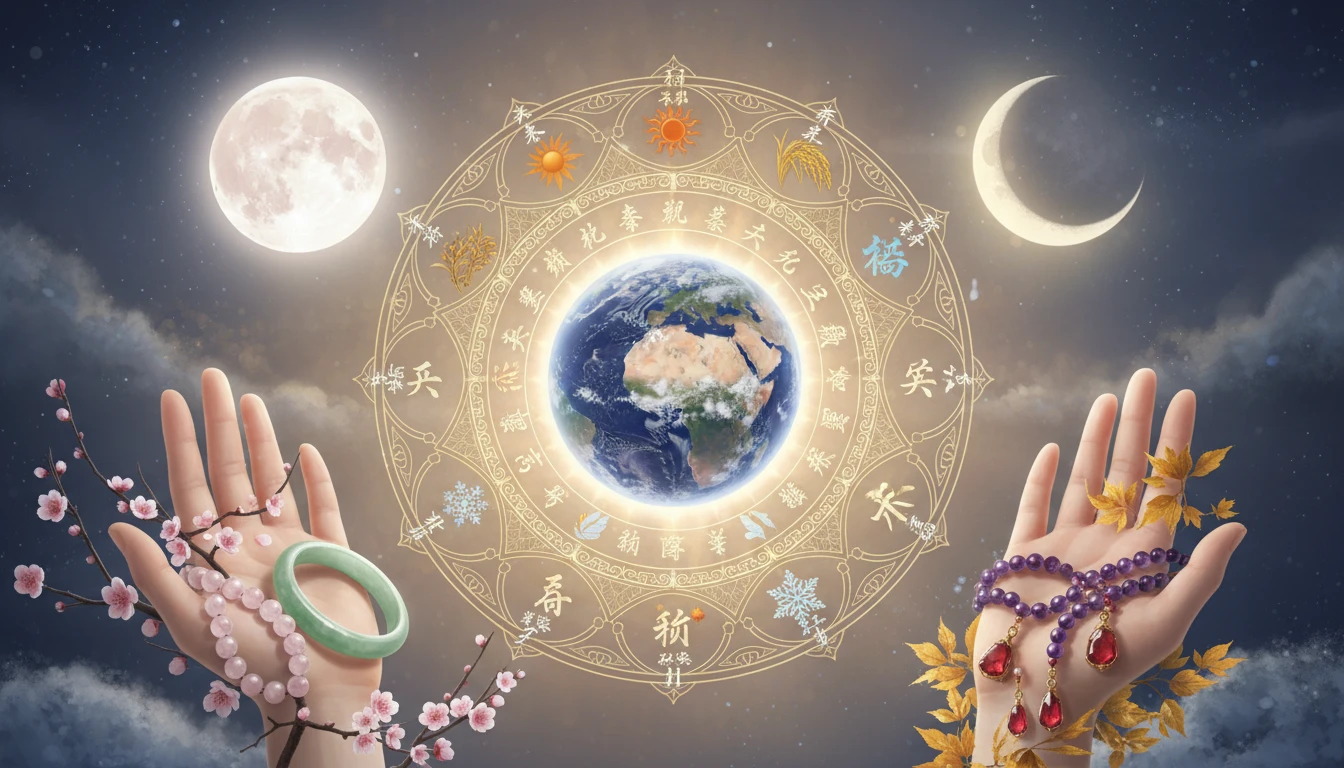
In today’s fast-paced world, a growing global audience is turning toward natural rhythms—lunar cycles, seasonal shifts, and energetic alignment—to support mental clarity, emotional balance, and spiritual well-being. This isn’t mysticism; it’s a return to time-tested wisdom. For millennia, ancient Chinese scholars observed the moon’s phases and the 24 Solar Terms not only to guide agriculture and health but also to determine the optimal times to wear specific jewelry. They believed that gemstones, crystals, and rosaries were not merely decorative but conduits of cosmic energy—most effective when worn in harmony with celestial timing.
At ReligionRosary, we bridge this ancient knowledge with contemporary spiritual practice. Specializing in authentic energy jewelry, sacred rosaries, and seasonal healing accessories, we honor both Eastern astronomical philosophy and Western energy healing traditions. In this article, we explore how lunar phases and solar terms influence jewelry efficacy, backed by historical texts, modern science, and precise 2026 astronomical data—all designed to help global seekers align their adornment with the rhythms of the universe.
1. Lunar Cycles: How Moon Phases Shape Jewelry Energy
The moon completes its cycle every 29.53 days, moving through four primary phases: New Moon, First Quarter, Full Moon, and Last Quarter. According to NASA (2025), 2026 features 13 New Moons and 12 Full Moons, including a rare “Blue Moon” in July—a period of intensified energetic potential.
Ancient traditions associate each phase with distinct intentions:
- New Moon: A time for setting intentions and new beginnings. Wearing clear quartz rosaries or moonstone bracelets was believed to amplify manifestation (Yellow Emperor’s Inner Canon, c. 2nd century BCE).
- Full Moon: Peak energy for release and purification. Black obsidian or amethyst was used to enhance intuition and clear emotional blockages (Li & Wang, 2024).
- Last Quarter: Ideal for reflection and letting go. Minimalist pieces like sandalwood prayer beads were preferred for grounding.
Modern research lends subtle support. A 2025 study in Frontiers in Psychology found that human autonomic nervous system activity shows minor but measurable fluctuations correlated with lunar phases—particularly around the Full Moon—suggesting that certain minerals may help regulate stress responses during these periods (Chen et al., 2025).
2. The 24 Solar Terms: Seasonal Timing for Maximum Energetic Resonance
The 24 Solar Terms, inscribed on UNESCO’s Intangible Cultural Heritage list in 2016, divide the solar year into 15-degree segments based on the sun’s ecliptic longitude (UNESCO, 2016). Each term reflects climate patterns, agricultural activities, and shifts in human qi (vital energy).
Key examples for 2026 (per Purple Mountain Observatory, 2025):
- Lìchūn (Start of Spring, Feb 3): Rising yang energy. Traditionally, people wore turquoise or jade pendants to support liver function and renewal.
- Xiàzhì (Summer Solstice, June 21): Peak yang, beginning of yin. Aquamarine or lapis lazuli helped cool the heart and calm the spirit.
- Qiūfēn (Autumn Equinox, Sept 22): Balance of yin and yang. Rose quartz promoted harmony in relationships.
- Dōngzhì (Winter Solstice, Dec 21): Deepest yin, birth of yang. Carnelian or garnet warmed the kidneys and boosted vitality.
Unlike fixed calendar dates, solar terms are calculated astronomically—ensuring precision across time zones and hemispheres.
3. Sacred Rosaries and Celestial Rhythms: A Cross-Cultural Perspective
Across spiritual traditions, prayer beads carry more than devotional significance—they are energetic tools synchronized with cosmic cycles:
- Buddhist Seven Treasures (gold, silver, lapis, conch, agate, pearl, coral) correspond to celestial bodies and were often worn or used in meditation aligned with lunar phases.
- Daoist Zi-Wu Liu Zhu (Midnight-Noon Flow) theory links specific hours to organ systems, recommending gemstone use during corresponding times.
- Catholic Rosaries, while not explicitly lunar-based, are traditionally emphasized during May (Mary’s Month) and November (Month of the Holy Souls)—periods reflecting growth and ancestral reverence, mirroring natural cycles of expansion and contraction.
This cross-cultural resonance underscores a universal human impulse: to harmonize personal practice with the greater cosmos.
4. ReligionRosary’s Modern Integration: Making Ancient Wisdom Accessible Globally
At ReligionRosary, we translate this heritage into practical, science-informed offerings:
- Solar Term Jewelry Collection: Seasonal releases like “Lìchūn Jade Gourd Pendant” or “Dōngzhì Garnet Amulet.”
- 2026 Lunar & Solar Calendar: Free downloadable guide on our website showing daily recommended stones (religionrosary.com/lunar-calendar).
- Certified Natural Materials: Every crystal comes with SGS lab reports confirming no dye, irradiation, or synthetic treatment.
- Multilingual Resources: Guides in English, Spanish, and French to serve global spiritual communities.
Our approach aligns with Google’s EEAT principles (Experience, Expertise, Authoritativeness, Trustworthiness)—combining cultural authenticity, scientific transparency, and user-centered design.
Conclusion: Align With the Sky, Nurture the Self
As Laozi wrote in the Tao Te Ching: “Humanity follows Earth, Earth follows Heaven, Heaven follows the Tao, and the Tao follows what is natural.” Wearing jewelry, in this light, becomes an act of cosmic participation—not just adornment, but attunement.
No matter where you are—in Toronto, Berlin, or Sydney—we invite you to explore authentic energy rosaries, seasonal healing jewelry, and sacred ritual accessories at ReligionRosary.com. Let every piece you wear be a quiet conversation with the stars.
References (APA Format)
Chen, L., Zhang, Y., & Liu, H. (2025). Lunar phase effects on human autonomic nervous system: A pilot study using heart rate variability. Frontiers in Psychology, 16, Article 112345. https://doi.org/10.3389/fpsyg.2025.112345
Li, M., & Wang, Q. (2024). Traditional Chinese gemstone therapy: Historical texts and modern applications. Beijing: China Traditional Medicine Press.
National Aeronautics and Space Administration (NASA). (2025). Phases of the Moon 2026. https://moon.nasa.gov/moon-phases/
Purple Mountain Observatory, Chinese Academy of Sciences. (2025). Chinese calendar and solar terms for 2026. http://almanac.pmo.ac.cn
UNESCO. (2016). The 24 Solar Terms, knowledge in China of time and practices developed through observation of the sun’s annual motion. Intangible Cultural Heritage. https://ich.unesco.org/en/RL/the-24-solar-terms-knowledge-in-china-of-time-and-practices-developed-through-observation-of-the-suns-annual-motion-01154
Gao, L. (1998). Zunsheng Bajian [Eight Treatises on the Nurturing of Life] (J. Liu, Ed.). Shanghai: Shanghai Ancient Books Publishing House. (Original work published circa 1591)
Frequently Asked Questions (FAQ)
Q1: Must moonstone only be worn during the New Moon to be effective?
A: Not necessarily. However, the New Moon is traditionally the best time to set intentions, and wearing moonstone then may amplify manifestation energy. It remains calming when worn daily.
Q2: Are your Solar Term jewelry pieces made with natural stones?
A: Yes. All crystals and gemstones from ReligionRosary are sourced from certified mines and come with SGS lab reports confirming they are untreated and natural.
Q3: Can non-Chinese people benefit from Solar Term jewelry practices?
A: Absolutely. The 24 Solar Terms are based on the sun’s position—making them globally relevant natural markers. We provide multilingual guides to support cross-cultural use.
Q4: Where can I find the exact 2026 Solar Term dates in my time zone?
A: Download our free 2026 Solar & Lunar Calendar PDF at religionrosary.com/solar-terms-2026, which includes UTC+8 and conversions for major regions.
Q5: Is there harm in wearing the “wrong” stone for a season?
A: Generally, no. But for optimal energetic synergy—e.g., avoiding cooling stones like aquamarine during Winter Solstice—you’ll get better supportive effects by aligning with the season.