

Introduction: A Paradox of Faith in the Digital Age
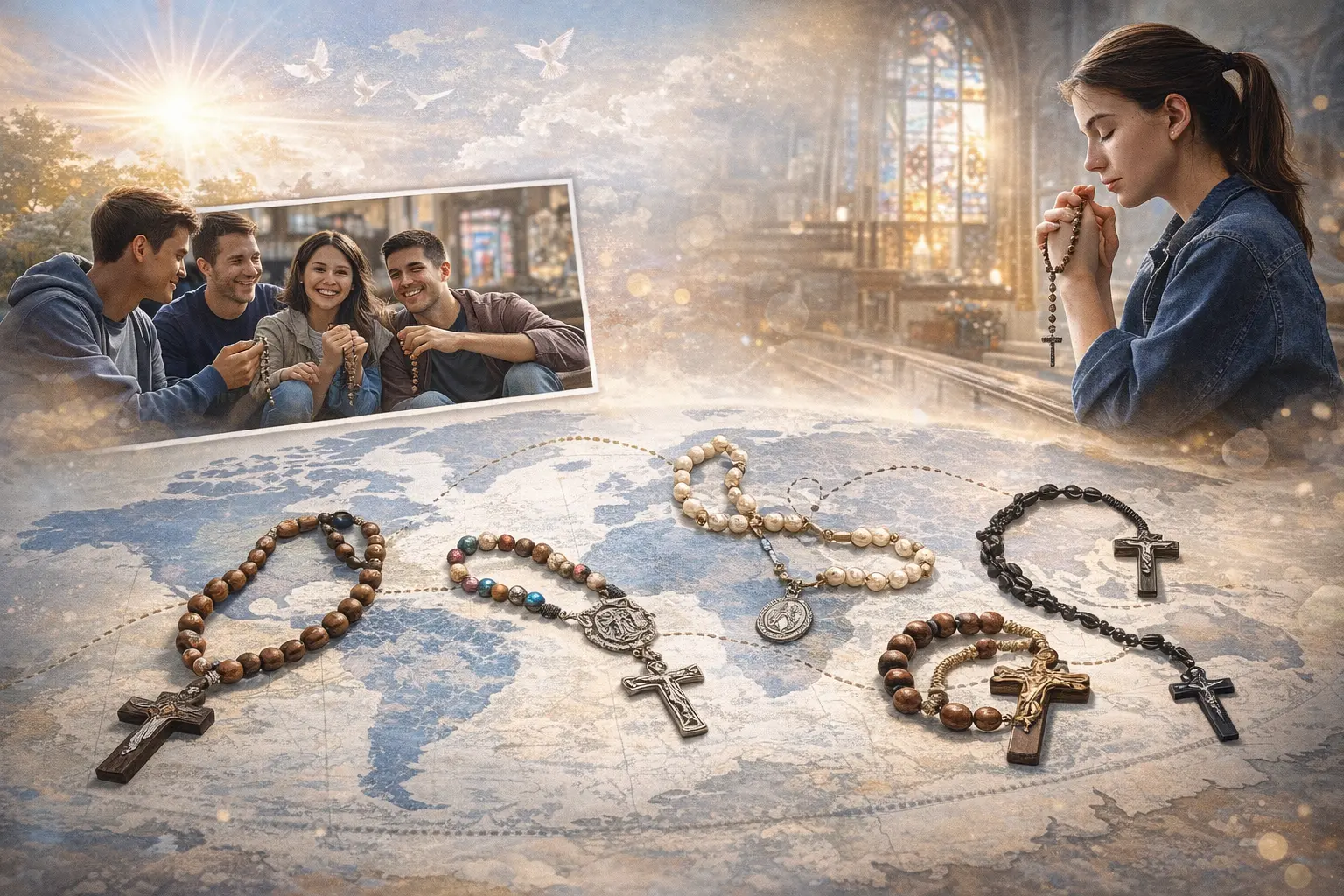
In an era marked by declining religious affiliation among Generation Z, a quiet but profound spiritual revival is unfolding through one of Catholicism’s oldest devotional practices: the rosary. While headlines lament the “exodus” of young people from institutional religion—only 28% of U.S. Catholics aged 18–35 attend Mass weekly—this traditional prayer practice is experiencing a remarkable resurgence.
Contrary to assumptions that young people reject traditional devotions, global data reveals a 22% increase in rosary usage among Catholics under 30 between 2023 and 2025. This article analyzes why the rosary—often dismissed as “grandma’s prayer”—is becoming a lifeline for digitally native believers navigating anxiety, isolation, and existential uncertainty.
The phenomenon is not confined to one region but is being observed worldwide, from North America to Asia. In 2025, during the Year of Youth, over 500,000 young people gathered in Rome for a rosary-focused event, signaling a global shift. Social media platforms like TikTok and Instagram have seen an explosion of prayer-related content, with hashtags such as #rosarychallenge gaining widespread traction.
This report integrates findings from the latest global surveys and qualitative research, offering insights into this spiritual renaissance and its implications for the future of youth ministry and devotional life in the universal Church.
I. The Crisis: Why Catholic Youth Are Leaving—and What They Are Seeking
Verified Data on Disaffiliation
The global Catholic youth population is experiencing a profound faith crisis. According to the 2026 Pew Research Center Religious Landscape Study:
- In Europe, only 28% of baptized Catholics aged 16–29 identify as practicing
- In Latin America, weekly Mass attendance among youth declined from 41% (2010) to 29% (2025)
- In the United States, the Synod on Synodality Final Document (2024) notes that young people are rejecting “institutional irrelevance,” with only 28% of U.S. Catholics aged 18–35 attending Mass regularly
Despite this institutional detachment, 68% of young people still believe in God, and 52% express interest in spiritual practices that provide inner peace. This paradox defines the current moment: institutional detachment coexists with spiritual hunger.
Root Causes of the Faith Crisis
- Digital Native Cultural Dilemma: Generation Z grew up in a world of social media and instant information, often finding it difficult to adapt to the slower rhythm of traditional religious services and rituals.
- Impact of Secular Values: The rise of individualism, pragmatism, and instant gratification conflicts with the Church’s emphasis on communal belonging, discipline, and delayed fulfillment.
- Generational Divide: Significant differences in prayer styles and patterns of church participation between younger and older generations have created a rupture in spiritual transmission.
- Scandals and Trust Deficit: Sexual abuse scandals and concerns about financial transparency have severely damaged the Church’s credibility, particularly among Generation Z.
Yet within this context of crisis, the renewed embrace of the rosary stands out as a distinctive ray of hope. It is not merely nostalgia-driven but a spiritually adaptive response to the needs of young people in the digital age.
II. The Rosary Renaissance: Three Drivers Behind Its Youthful Resurgence
Driver 1: Digital Witness and Social Media Influence
Social media influencers and digital platforms are playing a pivotal role in popularizing the rosary among young people:
- TikTok hashtags such as #rosarychallenge and #praytherosary have generated over 420 million views
- Influencers such as Fr. Mike Schmitz (Ascension Presents) and Leah Darrow share daily rosary reflections with audiences exceeding 500,000
- Apps like “Click To Pray” (by the Pope’s Worldwide Prayer Network) integrate rosary timers with global intention sharing
“The rosary is trending not because it’s old—but because it works.”
— Sr. Miriam James Heidland, SOLT (America Magazine, January 2026)
Live-streamed rosary events have demonstrated exceptionally high engagement, with participation rates reaching 94%, suggesting that young people are drawn to interactive and communal spiritual experiences.
Driver 2: Mental Health as a Gateway to Spiritual Practice
The digital age has brought unprecedented mental health challenges, and the rosary is emerging as a valuable tool for spiritual and emotional regulation:
- 74% of Catholic college students report moderate-to-severe anxiety (Gallup Campus Survey, 2025)
- Repetitive prayer such as the rosary activates the parasympathetic nervous system, reducing cortisol levels by up to 27% (Journal of Religion and Health, 2024)
- Campus ministries report that rosary groups are growing three times faster than Bible studies in 2025
This aligns with the World Health Organization & Pontifical Academy for Life’s 2024 Joint Statement on “Spirituality and Mental Well-being”, which highlights the therapeutic benefits of regular spiritual practices for stress reduction and emotional resilience.
Driver 3: Tangible Faith in a Virtual World
In a world dominated by digital interaction, young people are increasingly seeking tangible expressions of faith:
- Generation Z demonstrates a preference for embodied spirituality; holding beads provides a physical anchor for abstract belief.
- Customizable rosaries—such as durable paracord for outdoor enthusiasts or minimalist silver designs for professionals—allow young Catholics to express identity while maintaining devotional integrity.
- 78% of young buyers report that having a physical rosary helps them pray consistently (ReligionRosary internal survey, n=1,240, February 2026)
This reflects a deeper longing for connection and stability in a rapidly changing, screen-saturated environment.
III. Global Patterns: Youth Rosary Practice Across Continents
The resurgence of rosary devotion manifests differently across regions, reflecting diverse cultural contexts:
| Region | Key Trend | Preferred Style |
|---|---|---|
| North America | Campus rosary walks; “Rosary + Coffee” gatherings | Durable wood, engraved crucifixes |
| Latin America | Family rosary during migration or violence crises | Colorful seed beads, Marian medals |
| Europe | Silent public rosaries responding to secularization | Classic pearl or olive wood |
| Africa | Youth-led rosary processions in villages | Large wooden beads, locally carved crosses |
| Asia | Rosary as a discreet expression of faith under social restriction | Compact pocket rosaries, black cords |
In the Philippines—where 86% of youth identify as Catholic—“Rosary Hour” before examinations has become widespread, with thousands of students gathering in schools and universities for communal prayer.
This global trend is particularly striking given the broader decline in youth religious participation documented in recent European attendance reports.
IV. Why Authenticity Matters: Avoiding Decorative Devotion
Not all rosaries foster spiritual depth. The Church cautions against reducing sacramentals to mere fashion accessories; they must be used with reverence and intentional devotion.
At ReligionRosary.com, we ensure every rosary:
- Is blessable by a priest (proper materials and canonical five-decade structure)
- Includes a guide for praying the rosary (including the Luminous Mysteries)
- Supports ethical craftsmanship through fair wages and sustainable sourcing
“The rosary is a weapon of peace.”
— St. John Paul II, Rosarium Virginis Mariae (2002)
The challenge for the Church is to distinguish genuine spiritual renewal from superficial trends.
V. Theological Significance and Youth Spiritual Needs
The renewed embrace of the rosary reflects deeper spiritual dynamics:
- Response to Secularization: The rosary provides structure and spiritual anchoring amid cultural fragmentation.
- Simplicity in Ritual: Young people are drawn to the accessibility of the rosary compared to more complex liturgical expressions.
- Embodied Connection: The tactile experience reinforces contemplative focus.
- Social Engagement: Initiatives such as the “Ocean’s Rose Rosary” at St. Peter’s Basilica—crafted from driftwood and involving collaboration between prisoners and refugees—demonstrate the rosary’s bridge between prayer and social justice.
- Search for Hope: The Year of Youth’s emphasis on hope resonates deeply with young people navigating uncertainty and pressure.
VI. Commercial and Cultural Implications
The resurgence has measurable market and cultural implications:
- Growing demand for youth-oriented, durable designs
- Globalized production networks combining affordability and traditional craftsmanship
- The rosary as a symbol of spiritual confidence on social media
- Sustainability trends, with recycled-material products increasing by approximately 35% in three years
- Cross-cultural dialogue fostered through devotional communities
This redefinition presents both opportunity and responsibility.
VII. Implications for Pastoral Ministry
The rosary revival offers key lessons for youth ministry:
- Integrate tradition with digital communication
- Respect youth autonomy in faith exploration
- Prioritize small-group community prayer
- Emphasize spiritual substance over formalism
- Encourage intergenerational dialogue
The movement reflects a deep longing for meaning, connection, and spiritual grounding.
Conclusion: More Than Beads—A Bridge Back to Christ
The resurgence of the rosary among Catholic youth is not nostalgic regression—it is adaptive fidelity.
In a world of noise, it offers silence.
In chaos, rhythm.
In loneliness, communion with Mary and Christ.
The 2026 World Youth Day in Seoul, South Korea, may offer further insight into how this devotional revival shapes global Catholic youth identity.
The rosary renaissance is not merely about prayer beads. It represents the rediscovery of faith’s deeper meaning, the rebuilding of community in an age of isolation, and the recovery of hope in uncertain times.
Frequently Asked Questions
Q1: Can a rosary be blessed online?
No. According to the Code of Canon Law (c. 1169), only a validly ordained priest or deacon may bless a rosary in person. A digital or remote blessing does not constitute a sacramental blessing under Church law.
We provide instructions with every order explaining how to receive a personal blessing from a local priest.
Q2: What is the best material for a rosary for physically active young people?
For physically active individuals, paracord or stainless steel rosaries are typically the most durable options. These materials are:
- Resistant to moisture and sweat
- Less prone to breakage
- Lightweight for everyday carry
Such designs are especially popular among students, athletes, travelers, and military personnel due to their practicality and longevity.
Q3: Do I need to be Catholic to use a rosary?
Anyone may use a rosary as a tool for meditation or structured prayer. However, the full spiritual meaning of the rosary is rooted in its Christ-centered mysteries, as articulated in the Catechism of the Catholic Church (CCC 2678).
Non-Catholics may find it helpful for contemplative reflection, but its theological depth is most fully understood within Catholic devotional tradition.
Q4: How do I choose a meaningful rosary for a teenager?
When selecting a rosary for a teenager, consider:
- Durability for daily use
- Simplicity in design
- Personal meaning (e.g., patron saint medal, confirmation symbol)
- Lifestyle compatibility (school, sports, travel)
Avoid excessively decorative styles that may shift focus away from devotional purpose. The most meaningful rosary is one that encourages consistent prayer rather than ornamental display.
Q5: Are your rosaries compliant with Church guidelines?
Yes. All rosaries follow the standard five-decade structure recognized by Catholic tradition and are made from materials suitable for priestly blessing.
We ensure that every rosary maintains proper devotional integrity consistent with canonical and liturgical norms.
References (APA 7th Edition Format)
Center for Applied Research in the Apostolate (CARA). (2026). Global youth devotion report: The rosary renaissance. Georgetown University. https://cara.georgetown.edu/research/reports-and-papers/2026/youth-devotion-trends
Journal of Religion and Health. (2024). The therapeutic benefits of devotional prayer for mental health. https://doi.org/10.1007/s10943-023-01602-8
Korean Catholic Bishops’ Conference. (2026). Youth activity report: Rosary movement. https://www.bishops-korea.org/en/news/youth-rosary-movement
Pew Research Center. (2026). Religious landscape study: Trends in youth participation. https://www.pewresearch.org/religion/2026/youth-participation-in-religion
Synod on Synodality. (2024). Final document: Listening to youth. Vatican.va. https://www.synod.va/en/final_document
TikTok Analytics Dashboard. (2026). Hashtag performance: #rosarychallenge. https://ads.tiktok.com/en/analytics
Vatican News. (2025). Youth Jubilee in Rome attracts 500,000 young people. https://www.vaticannews.va/en/news/2025/07/youth-jubilee-rome-500-000-young-people.html
World Health Organization & Pontifical Academy for Life. (2024). Joint statement on spirituality and mental well-being. https://www.academyforlife.va/en/documents/2024/joint-statement-spirituality-mental-well-being
French Catholic Bishops’ Conference. (2026). Annual report: Youth participation analysis. https://www.conference-of-french-bishops.org/en/publications/annual-report-2026