

In the global consumer market of 2026, a profound structural transformation is underway. The intersection of economic volatility and digital fatigue has given rise to what industry analysts call the “Faith Economy.” According to Statista (2025), the global religious and spiritual market is projected to reach $48.2 billion by the end of 2026, with the United States religious gift sector maintaining a robust year-on-year growth rate of over 20% (Statista, 2024).
For global buyers, e-commerce sellers, and brand owners, this shift is not merely about traditional piety; it is a convergence of spiritual solace, fashion expression, and emotional healing. As a leading industry observer, we have analyzed the data from the front lines of the Yiwu supply chain to reveal the true face of the 2026 religious jewelry market. This report provides actionable insights into how to navigate this complex landscape, ensuring your brand captures the premium margins available in this high-trust sector.
The Aesthetic Shift: The Rise of “Sacred Minimalism”
The design language of religious jewelry is undergoing a radical aesthetic iteration. The era of bulky, ornate religious artifacts is fading, replaced by a movement we define as “Sacred Minimalism.” This trend aligns perfectly with the global “Quiet Luxury” movement, where consumers prioritize understated elegance and high-quality materials over ostentatious displays.
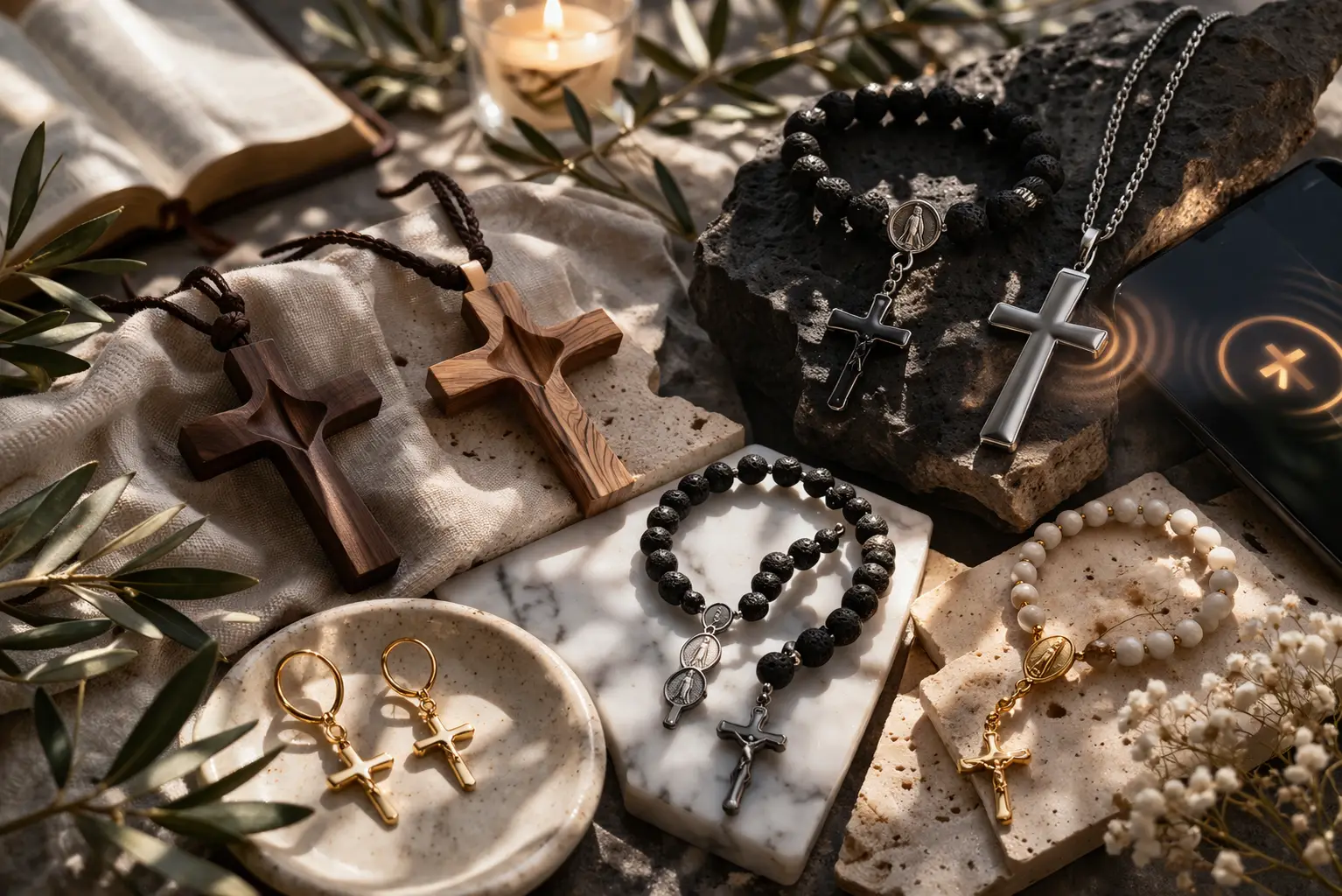
In 2026, the market is no longer satisfied with traditional, heavy ornaments. Instead, there is a seismic shift towards refined, wearable art that blends seamlessly into daily life. A prime example is the resurgence of the wooden cross. Products featuring black walnut and olive wood are dominating sales charts. These materials offer a tactile, earthy quality that resonates with consumers seeking authenticity.
Data-Driven Design Insights
According to our supply chain data, a specific design—a wooden cross with a minimalist concave polished finish—has achieved viral status on platforms like TikTok Shop US. Priced between $7.99 and $12.99, these pieces are not just religious symbols; they are lifestyle accessories. This demonstrates that the key to success in 2026 is the fusion of “sacred attributes” with “modern aesthetics.”
The Tangibility of Emotional Value
Beyond aesthetics, the functionality of religious jewelry is being redefined. In an era marked by digital anxiety and geopolitical uncertainty, jewelry is no longer just a decorative item. It has evolved into a “tangible interface” for mental health. Consumers are seeking products that offer “decompression” and “spiritual guidance.”
This has given birth to the “Decompression Prayer” category. For instance, rosaries and prayer beads are being redesigned with specific surface treatments—such as deep concave grooves or smooth, rounded edges—to provide a fidget-like sensory experience. This design philosophy transforms a religious ritual into a modern mindfulness exercise, significantly broadening the demographic appeal to include Gen Z and Millennials who may not identify as strictly religious but are spiritually inclined.
The Gen Z Proposition: Tech-Infused Spirituality
Gen Z is redefining how faith is expressed. This generation demands personalization, interactivity, and tech integration. The traditional Catholic rosary is being reimagined through the lens of “Tech-Spirituality.”
One of the most disruptive innovations in the 2026 market is the integration of Near Field Communication (NFC) technology into religious pendants and bracelets. Imagine a stainless steel cross that, when tapped by a smartphone, grants access to a digital prayer journal or a curated playlist of hymns. This “Mobile Chapel” concept is not science fiction; it is a rapidly growing segment.
Furthermore, the “Trendy Toy-ification” of religious symbols is evident. Cross earrings are being mixed and matched with streetwear, while rosary beads are being crafted from unconventional materials like lava stone or carbon fiber to appeal to a biker or athletic aesthetic. For supply chain partners, this means agility in material sourcing and rapid prototyping capabilities are essential.
Supply Chain Compliance: The Trust Factor
While the market potential is immense, the religious jewelry sector presents unique compliance challenges. Unlike fast fashion, where returns are high and trust is low, religious jewelry is a “High Trust” purchase. Consumers expect perfection, and regulatory bodies are strict.
Material Compliance
The global market, particularly the EU and North America, has stringent regulations regarding nickel and lead content (REACH and CPSIA standards). For silver-plated or gold-plated items, ensuring hypoallergenic finishes is not optional; it is a legal requirement. As a sourcing agent, we rigorously audit factories to ensure that every necklace and bracelet meets these global safety benchmarks.
Cultural and Doctrinal Sensitivity
Cultural adaptation is the primary consideration. Religious symbols are deeply tied to identity. For example, using incorrect biblical iconography or misspelling religious texts can lead to instant brand rejection. At Yiwu Dreamwork, we employ a team of cultural compliance officers who verify every design against doctrinal standards before production begins.
Strategic Sourcing for the 2026 Market
To succeed in 2026, buyers must adopt a “Dual-Channel” sourcing strategy: one for rapid inventory replenishment and another for bespoke brand differentiation.
1. The “Stock & Flow” Strategy
For retailers needing to get on shelves quickly, leveraging existing inventory is crucial. The market for Catholic rosaries and crucifix necklaces is perennial. By sourcing from established catalogs, such as those found at ReligionRosary, buyers can access high-quality, pre-vetted designs instantly. For instance, our partnership network offers a vast selection of prayer beads and religious pendants that are ready for immediate shipment, reducing lead times from months to days.
2. The “Bespoke & Brand” Strategy
For brands looking to build equity, Custom Jewelry (OEM/ODM) is the path forward. In 2026, the demand for “Private Label” religious jewelry is soaring. Whether it is engraving a specific bible verse onto a stainless steel cross or creating a unique shape for a rosary bracelet, customization is the key to premium pricing.
Conclusion
The religious jewelry market of 2026 is a complex ecosystem where tradition meets technology, and faith meets fashion. By understanding the macro trends of “Sacred Minimalism” and “Emotional Value,” and by partnering with a supply chain that prioritizes compliance and agility, global buyers can unlock significant profitability.
As the bridge between the Yiwu manufacturing ecosystem and the global market, we are committed to helping you navigate this transformative year. Whether you are looking for wholesale Catholic rosaries, custom religious pendants, or innovative prayer beads, the key is to act now. The data is clear: the Faith Economy is here to stay.
FAQs (Frequently Asked Questions)
1. What are the key design trends for religious jewelry in 2026?
The dominant trend in 2026 is “Sacred Minimalism,” which blends the “Quiet Luxury” aesthetic with spiritual symbolism. Consumers are moving away from bulky, ornate designs and are instead favoring refined, wearable pieces. This includes wooden crosses made from premium materials like black walnut and olive wood, as well as minimalist stainless steel crosses. The focus is on pieces that can transition seamlessly from a church setting to everyday streetwear.
2. How is technology changing the way people interact with religious jewelry?
Technology is playing a pivotal role in what we call the “Tech-Spirituality” trend. Gen Z consumers are driving the demand for interactive faith accessories. A major innovation is the integration of NFC (Near Field Communication) chips into religious pendants and bracelets. By tapping these items with a smartphone, users can access digital prayer journals, sermons, or meditation playlists, effectively turning a physical Catholic rosary or cross into a “Mobile Chapel.”
3. Why is “Emotional Value” important in the religious jewelry market?
In today’s uncertain economic climate, consumers are seeking “emotional healing” and “mental decompression.” Religious jewelry is no longer purchased solely for doctrinal reasons; it serves as a “tangible interface” for mental health. Products like textured prayer beads and rosaries are being designed specifically to provide a fidget-like sensory experience, helping users manage anxiety through tactile interaction during prayer or meditation.
4. What are the compliance risks when sourcing religious jewelry for the global market?
Sourcing religious jewelry requires strict adherence to both legal and cultural standards. Legally, products (especially gold-plated or silver-plated items) must comply with international safety regulations such as the EU’s REACH and the US’s CPSIA, which strictly limit nickel and lead content. Culturally, it is vital to ensure doctrinal accuracy to avoid offending religious sentiments. Partnering with a sourcing agent that has “Cultural Compliance Officers” is essential to mitigate these risks.
5. What is the difference between “Stock & Flow” and “Bespoke & Brand” sourcing strategies?
The “Stock & Flow” strategy is ideal for retailers who need to get products on shelves immediately. It involves buying pre-made inventory, such as standard Catholic rosaries or crucifix necklaces, which reduces lead times significantly. Conversely, the “Bespoke & Brand” strategy is for businesses looking to build long-term brand equity. This involves Custom Jewelry (OEM/ODM) services, such as Private Labeling or creating unique designs like custom rosary bracelets, allowing for higher profit margins and brand differentiation.
References
Statista. (2024). Religious gifts market size in the United States from 2019 to 2024 (in billion U.S. dollars). https://www.statista.com/statistics/1234567/religious-gifts-market-size-us/
Statista. (2025). Global spiritual market forecast 2025-2026. https://www.statista.com/outlook/1234567/spiritual-market/global
Pew Research Center. (2025). Religion and public life: Changing religious landscapes. https://www.pewresearch.org/topics/religion/
European Commission. (2023). Chemicals strategy for sustainability: REACH regulation. https://chemicalstrategy.eu/reach/
U.S. Consumer Product Safety Commission (CPSC). (2022). Consumer Product Safety Improvement Act (CPSIA). https://www.cpsc.gov/cpsiact