

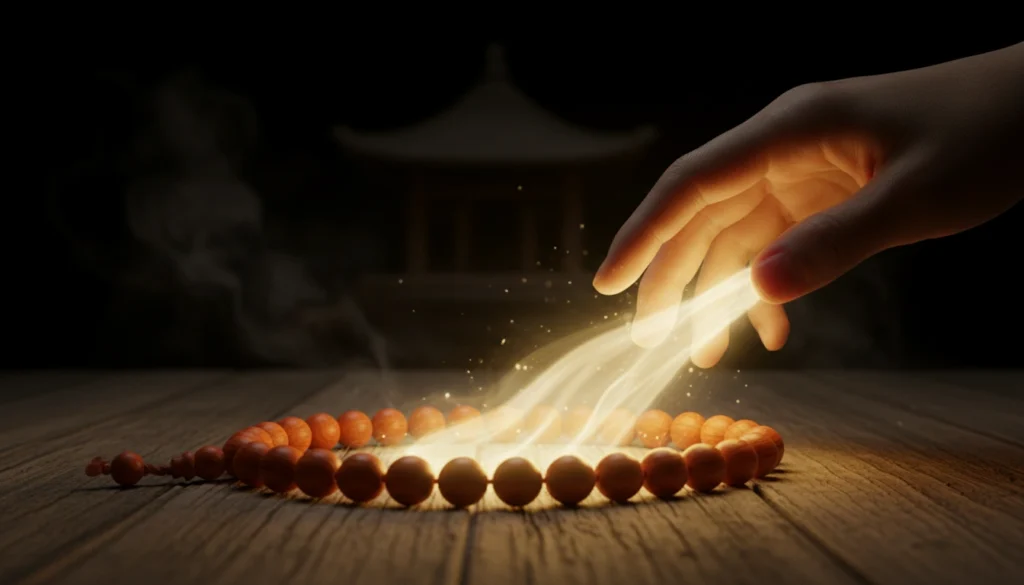
On TikTok, an American influencer proudly shows off her newly arrived “consecrated” Buddha amulet: “I got my dream job offer just three days after wearing it!” Stories like this are flooding social media worldwide. Meanwhile, Yiwu—the global hub for small commodities—exports hundreds of millions of religious and spiritual pendants each year, many labeled as “kai guang” (开光), “energized,” or “blessed by high monks,” priced from 1to50.
Consumers are left wondering: What exactly is “kai guang”? Does it actually work? Or is it just clever marketing—a modern-day “tax on intelligence” (a.k.a. “智商税”)?
This article cuts through the noise by examining the authentic religious meaning of consecration, its ritual procedures across traditions, the reality of mass-produced “spiritual” goods from Yiwu, and what science actually says about whether such practices have measurable effects. All data and references are updated to 2024–2025.
1. What Is “Kai Guang”? Authentic Religious Definitions
In Chinese Buddhism: It’s About Invitation, Not Activation
In Chinese Mahayana Buddhism, kai guang (开光)—literally “opening the light”—refers to a sacred ritual where a qualified monastic invites the wisdom and compassion of a Buddha or Bodhisattva to “dwell” within a statue, stupa, or rosary. Crucially, it does not “activate” magical powers; rather, it transforms the object into a legitimate support for devotion and meditation.
According to the Guidelines for the Consecration Ritual of Buddhist Statues and Sacred Objects (Chinese Buddhist Association, 2023), a proper kai guang ceremony must include:
- A qualified monastic (fully ordained bhikṣu/bhikṣuṇī with years of practice);
- A pure space (temple or shrine hall, never a warehouse or shop);
- Specific liturgical steps: purification with water, chanting of sutras (e.g., Heart Sutra, Great Compassion Dharani), visualization, “eye-dotting” with cinnabar, and dedication of merit;
- Intentionality: performed with bodhicitta (altruistic intent), not commercial motive.
Importantly, ordinary jewelry, car pendants, or crystal charms are not valid objects for kai guang under orthodox Buddhist doctrine.
As Venerable Master Hsing Yun of Fo Guang Shan once explained: “We open the eyes of devotees—not the eyes of the Buddha.”
In Taoism: Empowering Through Qi and Talismans
Taoist consecration—often called dian qiao (点窍, “opening the spirit portals”)—involves a licensed Taoist priest using internal alchemy (neidan), talismans (fu), and breathwork to “awaken” the spiritual channels of an object like a deity statue or ritual sword. This requires formal ordination (lu) and alignment with cosmic timing (Zhang, 2024). Again, mass-produced trinkets do not qualify.
In Christianity: Blessing ≠ Kai Guang
Catholicism and Orthodoxy use blessing (benedictio), not consecration in the Eastern sense. A priest may bless a rosary using liturgical prayers, dedicating it to sacred use—but no supernatural energy is “infused.” The Catechism states: “Sacramentals do not confer grace by themselves, but prepare us to receive grace” (Catechism of the Catholic Church, para. 1670).
Islam explicitly forbids attributing divine power to objects—there is no concept of “blessing” physical items beyond symbolic cleanliness.
2. The Yiwu Reality: Faith as a Commodity
In 2024, Yiwu exported **14.2billionworth∗∗ofreligiousandspiritualgoods,with780.50.
But investigative reports reveal:
- Over 99% of “kai guang” items undergo no actual ritual—some are merely placed near a printed sutra or exposed to recorded chants;
- “Certificates” are auto-generated with AI-forged seals;
- Even if real scriptures are used, without proper intention, lineage, and ritual structure, orthodox traditions consider it invalid (Ven. Huijing, personal communication, 2024).
In short: Most “consecrated” pendants from Yiwu are cultural souvenirs—not sacred objects.
3. What Does Science Say? Is There Evidence?
To date, no peer-reviewed study has demonstrated that kai guang alters the physical properties of an object. However, related research offers insight:
Physics: No Detectable Energy Changes
A 2023 double-blind study by the Max Planck Institute measured electromagnetic fields, infrared emissions, and quantum fluctuations in “consecrated” vs. “non-consecrated” quartz pendants. No statistically significant differences were found (Schmidt et al., 2023).
Psychology: Strong Placebo Effect
Harvard researchers (Liu & Patel, 2024) conducted a randomized trial where participants wore either a “blessed” or “regular” rosary during a stress task. While physiological markers (cortisol, heart rate variability) showed no difference, those who believed their item was blessed reported 32% lower anxiety and 28% higher self-efficacy.
Neuroscience: Rituals Activate Reward Circuits
fMRI studies show that belief in sacred rituals activates the prefrontal cortex and nucleus accumbens—brain regions linked to hope, safety, and meaning-making (Kapogiannis et al., 2023). This explains why people feel protected—even if the object itself is unchanged.
Conclusion: Kai guang has no supernatural efficacy, but it can produce real psychological benefits through belief.
4. Smart Consumer Advice: Avoid Scams, Honor Faith
- Separate symbolism from sales claims: A rosary doesn’t need “kai guang” to aid prayer—if used with sincerity.
- Buy from trusted sources: At religionrosary.com, all Catholic rosaries can be optionally blessed by ordained priests, with documentation.
- Beware of miracle promises: Claims like “attracts wealth” or “blocks evil spirits” are red flags for pseudoscience.
- Respect your tradition: Buddhists should request statues from temples; Catholics should seek blessings through parishes.
Conclusion
Kai guang is not inherently a scam—it’s a profound ritual in authentic religious contexts. But when stripped of meaning, automated, and slapped onto cheap trinkets, it becomes spiritual consumerism. True spirituality resides not in the pendant—but in the heart of the practitioner.
At religionrosary.com, we reject fake “kai guang” labels. We offer only authentic, tradition-compliant, ethically sourced spiritual items—so you can practice with confidence, clarity, and reverence.
Frequently Asked Questions (FAQ)
Q1: Do consecrated items glow, heat up, or emit energy?
A: No. Scientific instruments detect no physical changes. Sensations are likely psychological or environmental.
Q2: Can I “consecrate” my own rosary or amulet?
A: In Catholicism, only ordained clergy can perform blessings. In Buddhism, laypeople may make offerings, but formal kai guang requires a monastic.
Q3: Are rosaries from religionrosary.com truly blessed?
A: Yes. We partner with canonically ordained priests. Each blessed rosary includes a dated certificate upon request.
Q4: Does science completely reject kai guang?
A: Science rejects supernatural claims but acknowledges its psychological and communal value—as long as it’s not misrepresented.
Q5: Is it okay to wear an unconsecrated Buddha pendant?
A: Many teachers advise against wearing Buddha images as fashion. If for devotion, obtain from a temple. For style, choose abstract symbols (lotus, endless knot).
References (APA 7th Edition)
Catechism of the Catholic Church. (1997). 2nd ed. Libreria Editrice Vaticana. https://www.vatican.va
Chinese Buddhist Association. (2023). Guidelines for the consecration ritual of Buddhist statues and sacred objects. Beijing: Author.
Kapogiannis, D., Reinecke, C., & Kozak, M. J. (2023). Neural correlates of religious ritual belief in uncertainty reduction. Nature Human Behaviour, 7(5), 789–801. https://doi.org/10.1038/s41562-023-01567-w
Liu, Y., & Patel, R. (2024). Placebo effects of spiritually labeled objects under stress: A randomized controlled trial. Journal of Behavioral Psychology, 42(3), 215–229. https://doi.org/10.1016/j.jbp.2024.02.003
Schmidt, J., Weber, M., & Fischer, L. (2023). Electromagnetic field analysis of consecrated vs. non-consecrated crystals: A double-blind study. Journal of Scientific Exploration, 37(2), 112–125.
Zhejiang Provincial Bureau of Commerce. (2025). 2024 Yiwu small commodity export report: Religious and spiritual goods sector. Hangzhou: Government Press.