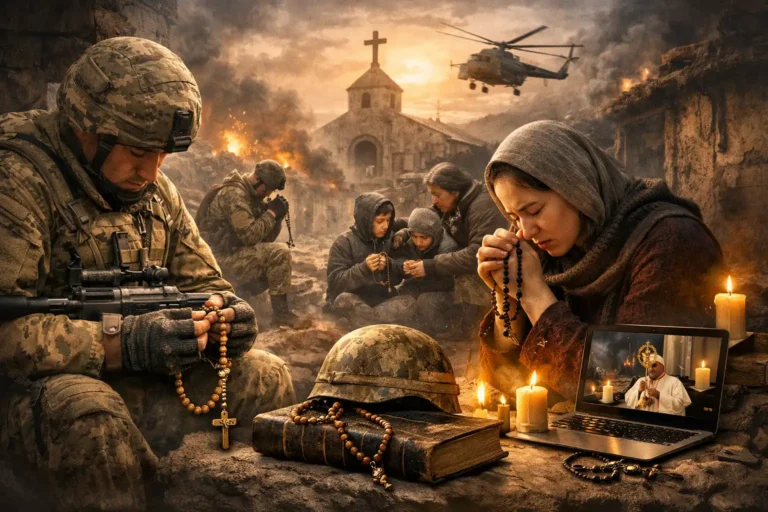


Abstract: Throughout the long river of human history, war and peace have always been alternating themes. Some argue that war is a catalyst for resource redistribution and technological acceleration; others firmly believe that peace is the cornerstone of civilization’s survival. This article will deeply explore the real impact of war on the wealth gap and social structure, and combine religious spirituality, particularly the practice of the Religious Rosary, to explore how individuals can build an inner sanctuary in a turbulent world, achieving a leap from “external peace” to “inner peace.”
I. Introduction: The Crossroads of Civilization
The world of 2026 remains geopolitically complex. From a historical dimension, humanity has never stopped debating “whether war is necessary.” Theories like the Thucydides Trap and Malthusianism seem to suggest the inevitability of conflict. However, when we strip away the political and economic layers and look directly at the essence of war, we see countless broken families, destroyed faith, and a deep questioning of the human soul.
If this world were without war, human resources would no longer be consumed by destructive weapons but would be fully invested in healthcare, education, and the exploration of the universe. But the reality is that war seems to be a constant shadow. So, how should we, as ordinary people, survive in this era of uncertainty? The answer perhaps lies not in political maneuvering, but in the depths of our hearts—through religious faith and spiritual practices, such as reciting the Rosary, to build an unshakable inner order.
II. The Dual Face of War: Development or Destruction?
1. The Myth of War as an “Accelerator”
Indeed, many technological breakthroughs in history originated from wartime needs. For example, World War II spawned radar, jet engines, and nuclear technology; the Cold War propelled the aerospace industry and the internet (ARPANET). The economic theory of “Creative Destruction” proposed by Joseph Schumpeter is often used to defend war, suggesting that the destruction of old orders can bring about the prosperity of new economies.
However, this viewpoint ignores the huge hidden costs. According to World Bank data, the economic cost of modern war is several times its reconstruction cost. War brings not general prosperity, but the exorbitant profits of a tiny military-industrial complex and the abject poverty of the vast majority of civilians.
2. War as the Ultimate Driver of the Wealth Gap
War is the most violent means of wealth distribution, often leading to a sharp widening of the gap between rich and poor.
* Resource Plunder: Wars often revolve around resources (oil, minerals, land). The victors seize resources, while the losers lose everything.
* Refugee Crisis: War creates the largest number of poor people in the world—refugees. UNHCR data shows that every minute, 20 people are forcibly displaced due to conflict or persecution.
* Data Evidence: Before the Syrian war, the country’s Gini coefficient was around 0.3, indicating relatively fair income distribution. After the war, due to destroyed infrastructure and wealth concentration, the Gini coefficient soared to above 0.5, with a poverty rate exceeding 90%.
War is not the inevitable path for accelerating social development, but a huge regression of human civilization. It drags human civilization back to the baseline of survival, depriving people of the opportunity to pursue a spiritual life.
III. Finding Faith in the Ruins: The Role of Religion
When the external world collapses, humans often turn to religion for comfort. Religion not only provides a framework for explaining suffering but also offers spiritual motivation for rebuilding lives.
Among many religious traditions, Christianity (particularly Catholicism) offers a uniquely powerful spiritual tool—the Religious Rosary. This is not merely a string of beads, but a “spoken Bible” meditating on the life of Christ.
1. Historical Context of the Rosary: Light Born in Dark Times
The history of the Rosary dates back to the Middle Ages. At that time, Europe was plagued by frequent wars and the Black Death, and people lived in extreme fear. The Virgin Mary transmitted the Rosary to humanity through St. Dominic as a weapon against heresy and a means to obtain inner peace. In that age without peace, the Rosary became the spiritual pillar of the faithful.
2. Structure and Metaphor of Peace
The Rosary consists of the Joyful, Sorrowful, Glorious, and Luminous Mysteries, covering the lives of Jesus and the Virgin Mary.
* Joyful Mysteries: Symbolize hope and new beginnings, like the dawn of post-war reconstruction.
* Sorrowful Mysteries: Face suffering and sacrifice directly, helping us find meaning in the world’s pain.
* Glorious Mysteries: Look forward to eternal peace and victory, giving us a perspective that transcends worldly suffering.
Through the repeated recitation of the “Our Father,” “Hail Mary,” and “Glory Be,” the believer’s heartbeat and breathing gradually synchronize with the rhythm of prayer. This physiological “Relaxation Response” can effectively lower cortisol levels and combat anxiety.
IV. Survival Guide in a Contentious World: From External Struggle to Inner Practice
Since war cannot be eliminated instantly, how should we survive? The answer is: Look Inward.
1. Building a Personal “Spiritual Sanctuary”
No matter how noisy the outside world is, you can create a sacred private space through reciting the Rosary. This requires no special location, only a string of Religious Rosary Beads and a heart willing to be quiet.
* Step 1: Choose Your Tool. A good Catholic Rosary Beads is not just a counting tool but a symbol of faith. You can choose wood, crystal, or Jerusalem Beads made of olive wood, where every bead represents a prayer for peace.
* Step 2: Enter a Meditative State. Do not just recite mechanically. When holding Religious Jewelry, imagine yourself walking the Via Dolorosa or standing beside the Virgin Mary. This empathy allows you to detach from personal trivial worries and see the grander picture of redemption.
2. The Rosary as a “Spiritual Weapon”
In spiritual tradition, the Rosary is regarded as the “most powerful prayer.” Popes have repeatedly called on believers to pray for world peace through the recitation of the Rosary. This is not an escape, but a spiritual warfare. Through prayer, you radiate the energy of peace to your community, thereby influencing the world.
3. Keyword Integration: Integrating Faith into Life
In this material world, Religious Jewelry can become an externalized mark of your faith.
* Wearing a Cross Necklace: Remind yourself of Christ’s sacrifice and love, the ultimate antidote to hatred.
* Using Rosary Beads as Decoration: This is not just fashion, but a declaration—I belong to a peace-seeking community.
* Collecting Religious Statues: Place a statue of the Virgin Mary or Jesus at home, making your home a “Domestic Church” to resist external chaos.
V. Conclusion: A World Without War and Our Responsibility
If this world were without war, humanity might have already landed on Mars or conquered all diseases. But regrettably, as long as greed, pride, and hatred remain in the human heart, the shadow of war will not dissipate.
However, changing the world begins with changing oneself. We cannot force nations to lay down arms, but we can choose to let go of the anger in our hearts; we cannot instantly eliminate the wealth gap, but we can help those around us through charity and prayer.
In this turbulent era, religionrosary.com hopes to be a lighthouse for you seeking inner peace. We not only provide high-quality Religious Rosary and Faith Supplies but also hope to help you live out Christ-like peace in this contentious world by sharing the spiritual wisdom of the Rosary.
Pick up your Rosary Beads and start today’s prayer. For every sincere prayer is a cornerstone for a peaceful world.
Frequently Asked Questions (FAQ)
Q1: Why persist in reciting the Rosary in modern society?
A: Although technology changes with each passing day, the structure of the human soul has not changed. Modern people face unprecedented anxiety and loneliness. The Rosary, as a rhythmic form of meditation combining scripture recitation with visual meditation, can effectively help modern people focus, relieve stress, and find a sense of belonging in faith.
Q2: Are there any special considerations for Religious Rosary Beads?
A: Yes. A standard Catholic Rosary consists of 59 beads, including 5 “decades” and 1 “mystery” part. In terms of material, wooden beads usually symbolize humility, while crystal or semi-precious stone beads are often used to deepen the sensory experience during prayer. Most importantly, beads are tools to assist prayer, not magic objects.
Q3: Can reciting the Rosary really bring peace to the world?
A: From a theological perspective, prayer has the power to change reality. From a psychological perspective, when a person becomes peaceful and loving through prayer, their way of handling interpersonal relationships changes. The ripple effect of this positive energy will gradually spread and eventually have a positive impact on society.
Q4: Can I wear Religious Beads in non-Catholic occasions?
A: Of course. Although the Rosary is a core Religious Jewelry of Catholicism, in many cultures, beads are also seen as a spiritual symbol. As long as it is out of respect, wearing Religious Beads can be an expression of personal faith and values.
Q5: How do I start learning to recite the Rosary?
A: You can start with simple steps: first, obtain a string of Rosary Beads, then look up the “Rosary Prayers” and recite along with them. There are many mobile apps and websites (like religionrosary.com) that provide illustrated guides and audio assistance to help beginners get started quickly.
Reference List
* United Nations High Commissioner for Refugees. (2025). Global trends: Forced displacement in the world. https://www.unhcr.org/global-trends/
* World Bank. (2024). The economic cost of conflict and violence. https://www.worldbank.org/en/topic/conflictsecurityanddevelopment
* Mariani, M. (2023). The Rosary: A History of the Holy Rosary. Catholic Truth Society.
* Benson, H. (2022). The Relaxation Response: The Therapeutic Effects of Meditation and Prayer. HarperOne.
* BBC News. (2024, January 15). Syria’s economy: How conflict has devastated a nation. BBC News Middle East.