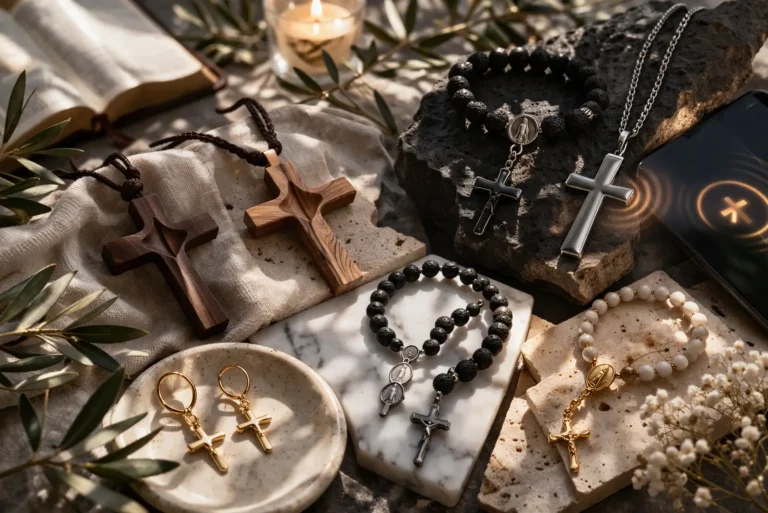

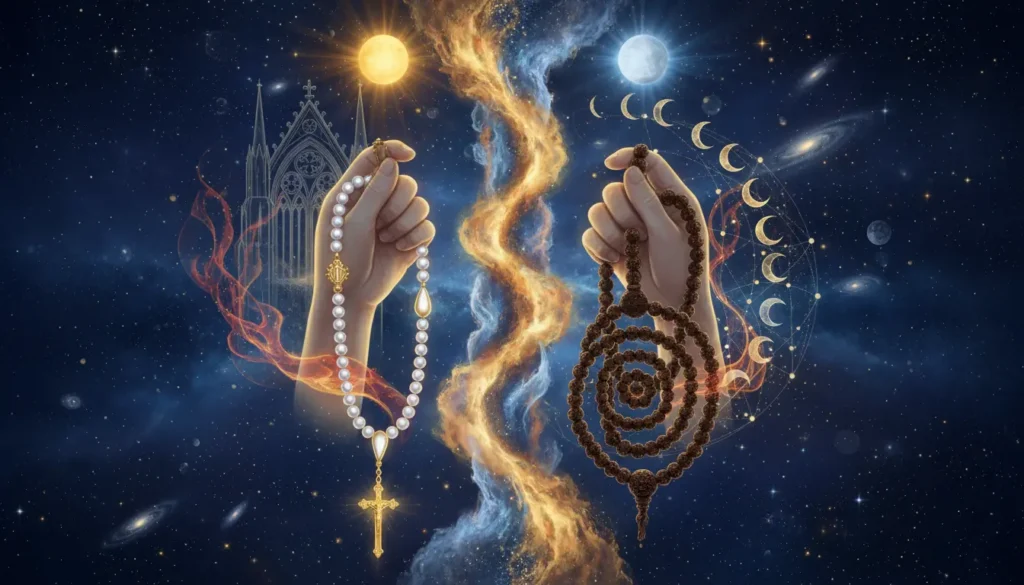
In today’s globalized world, religious prayer beads—such as the Catholic rosary and the Buddhist mala—have transcended their devotional origins to become symbols of spiritual depth and cultural heritage. At first glance, they may appear similar: strings of beads used for counting prayers or mantras. But beneath this surface resemblance lie profoundly different cosmologies, philosophical frameworks, and even astronomical insights.
From bead count and structure to material choice and ritual use, each tradition encodes a unique vision of the universe. In this article, we explore how these sacred tools reflect distinct understandings of time, space, divinity, and human purpose—and why their wisdom remains relevant in our modern age.
1. Historical Origins: From Monastic Practice to Spiritual Technology
The Catholic rosary evolved in medieval Europe as a layperson’s adaptation of monastic prayer. Monks traditionally recited all 150 Psalms daily, but illiterate faithful sought an alternative. They began using knotted cords or beads to count 150 Ave Marias (Hail Marys)—a “psalter of Mary.” By the 15th century, this practice merged with meditations on key events in Christ’s life, forming the Mysteries of the Rosary: Joyful, Sorrowful, Glorious, and Luminous.
Today’s standard rosary features:
- A crucifix (symbolizing Christ’s sacrifice)
- 59 beads: 5 decades of 10 small beads (for Hail Marys), separated by larger beads (for Our Father prayers)
- A short strand with 5 additional beads (for introductory prayers)
This structure mirrors Christianity’s linear narrative of salvation: from Incarnation to Passion, Resurrection, and ultimate glory.
In contrast, the Buddhist mala traces its roots to ancient India. The Sutra of the Buddha’s Instructions on the Use of Bodhi Seeds recounts how the Buddha advised King Virudhaka to use 108 wooden beads to calm the mind and overcome afflictions. As Buddhism spread to China, Tibet, and Japan, the mala absorbed local cosmological ideas—especially those linking human practice to celestial cycles.
Unlike the rosary’s fixed form, malas vary widely:
- 108 beads (most common)
- 27, 21, 18, or even 1,080 beads—each number tied to specific teachings
- Materials include bodhi seeds, sandalwood, lotus seeds, bone, crystal, or rudraksha
This flexibility reflects Buddhism’s emphasis on adaptation, interdependence, and inner transformation.
2. Structure & Symbolism: Two Visions of Reality
The Catholic Rosary: A Vertical Journey Toward Heaven
The rosary is not just a counter—it’s a spiritual ladder. The crucifix grounds the user in earthly suffering; the decades guide meditation through Christ’s redemptive acts; the final prayers ascend toward divine glory. This vertical, linear progression embodies core Christian beliefs:
- Time has direction (Creation → Fall → Redemption → Eternity)
- Salvation comes through historical events
- The soul journeys from sin to grace
Even the five-decade structure echoes the Pentecost—the 50th day after Easter—when the Holy Spirit descended, empowering the Church. Thus, the rosary ties personal prayer to cosmic history.
The Buddhist Mala: A Web of Interbeing
The mala, especially in Mahayana and Vajrayana traditions, reflects the Indra’s Net metaphor from the Avatamsaka Sutra: a vast cosmic net where every jewel reflects all others, symbolizing universal interdependence.
Key elements:
- Mother bead (sumeru/guru bead): Represents the Buddha or enlightenment
- 108 beads: Symbolize the 108 worldly desires or defilements to purify
- Tassel or marker: Signifies the path’s culmination—nirvana
Rather than moving upward, the practitioner moves inward and outward simultaneously, recognizing that liberation arises not from escaping the world, but from seeing its true nature.
3. The Meaning of Numbers: Astronomy, Time, and Cosmic Order
Why 59 Beads? The Christian Calendar in Miniature
The rosary’s 59-bead count isn’t arbitrary:
- 50 Hail Marys = the 50 days of the Easter season culminating in Pentecost
- 5 decades = the five wounds of Christ or five joyful/sorrowful mysteries
- 3 introductory beads = the Trinity
This design embeds liturgical time into daily devotion—turning prayer into a microcosm of sacred history.
Why 108? The Universe in a String
The number 108 appears across Dharmic traditions:
- In Indian astronomy: 27 lunar mansions × 4 phases = 108
- In Chinese cosmology: 12 months + 24 solar terms + 72 pentads = 108
- In yoga: 108 energy lines converge at the heart chakra
- In Buddhism: 108 types of craving that bind beings to samsara
Thus, each turn of the mala aligns the practitioner with cosmic rhythms—not as passive observer, but as active participant in universal harmony.
| Feature | Catholic Rosary | Buddhist Mala |
|---|---|---|
| Primary Count | 59 beads | 108 beads |
| Cosmic Model | Linear, vertical (Earth → Heaven) | Cyclical, holographic (Indra’s Net) |
| Time Concept | Salvation history (past → future) | Eternal now (samsara ↔ nirvana) |
| Divine Focus | Personal God (Trinity) | Impersonal Dharma / Buddha-nature |
| Goal of Use | Meditate on Christ’s life; seek grace | Purify mind; realize emptiness |
4. Modern Relevance: From Ritual Object to Cultural Icon
Both rosaries and malas have entered mainstream fashion—but their spiritual power endures.
- Buddhist malas are now worn by celebrities and wellness enthusiasts as mindfulness aids. Yet traditional teachers caution: wearing without understanding risks cultural appropriation. True value lies in intentional practice, not aesthetics.
- Catholic rosaries have seen renewed interest, especially among youth drawn to tangible faith expressions. Pope Francis calls the rosary a “weapon against evil”—not magic, but a school of contemplation.
At ReligionRosary.com, we honor both traditions by offering authentic, ethically sourced beads—whether you seek a blessed rosary from Italy or hand-knotted mala from Nepal.
Conclusion: Two Paths, One Human Quest
The Catholic rosary and Buddhist mala are more than jewelry. They are portable cosmologies—miniature universes strung on thread.
One invites us to walk with Christ through sorrow into light.
The other guides us to dissolve illusion and awaken within the web of all things.
In a fragmented world, these ancient tools remind us: true peace begins when we align our breath, our beads, and our being with something greater than ourselves.
Whether you pray to Mary or chant Om Mani Padme Hum, may your beads carry you closer to truth, compassion, and wonder.
Explore authentic Catholic rosaries and Buddhist malas at religionrosary.com — where tradition meets transcendence.