
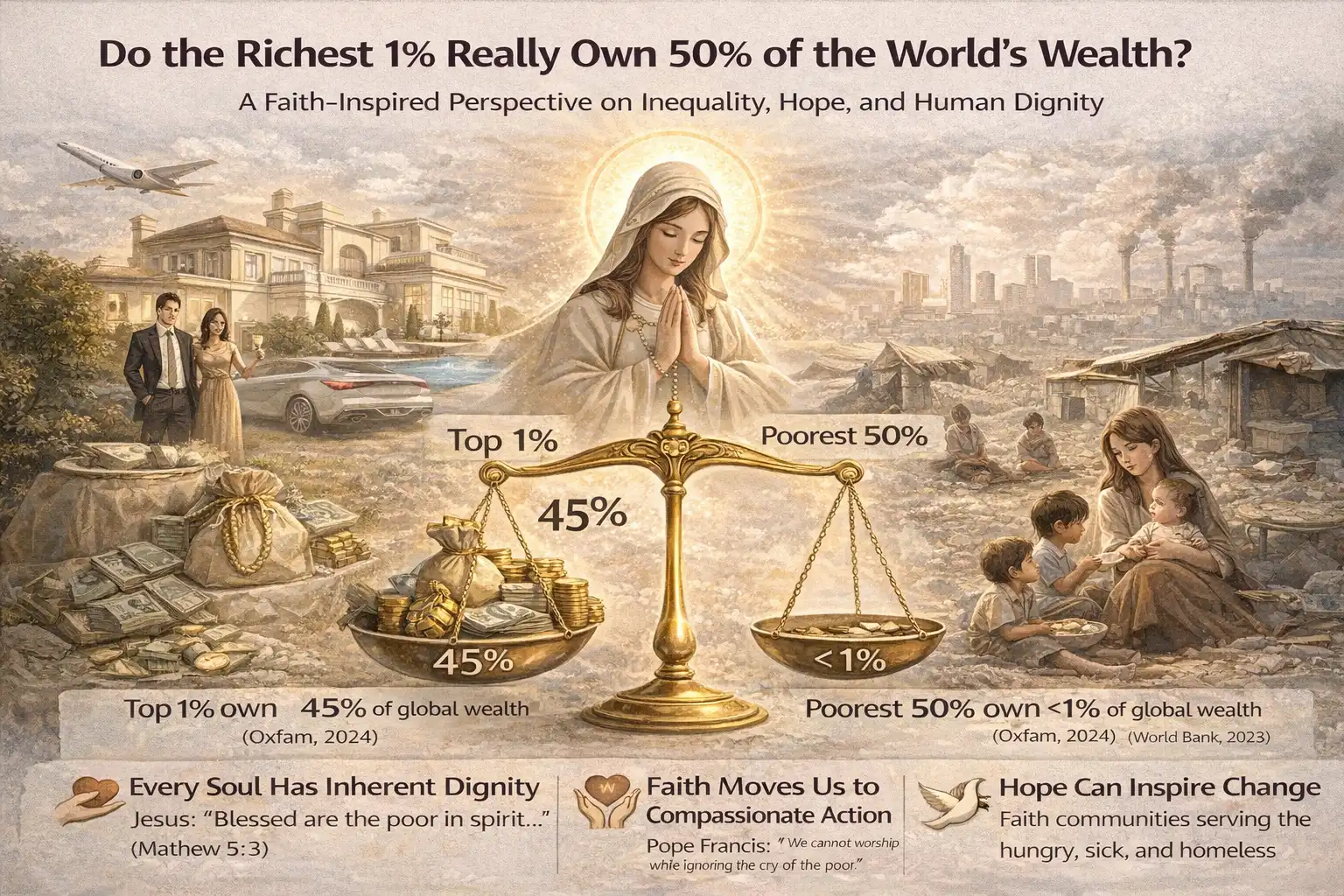
In today’s interconnected world, a startling statistic circulates widely: the richest 1% of the global population owns nearly half of the world’s wealth. According to Oxfam’s 2024 report Inequality Inc., as of late 2023, the top 1% held approximately 45% of global wealth, while the poorest 50% owned less than 1% (Oxfam, 2024). Meanwhile, nearly half of humanity—over 3 billion people—lives on less than $ 6.85 per day, the World Bank’s updated international poverty line (World Bank, 2023).
Faced with such extreme disparity, it’s natural to feel anger, despair, or even moral outrage. Why are some born into luxury and opportunity, while others struggle daily for clean water, food, or shelter? Does this mean those at the bottom are destined for misery? Is the world fundamentally unjust?
While economic inequality is undeniably real—and often deeply painful—viewing human worth solely through the lens of material wealth leads to a distorted and ultimately hopeless worldview. This article invites you to consider a broader, more compassionate, and spiritually grounded perspective—one that acknowledges injustice without surrendering to cynicism, and that sees dignity, resilience, and grace even in the midst of hardship.
1. The Data: Wealth Concentration Is Real—but Not Immutable
First, let’s clarify the facts. Though the phrase “the 1% owns 50%” is commonly cited, the most recent data from Credit Suisse’s Global Wealth Report 2023 shows the figure is slightly lower—around 44–45% (Credit Suisse, 2023). Still, this level of concentration is historically extreme. For context, during the mid-20th century, progressive taxation, strong labor unions, and public investment in education and healthcare significantly reduced inequality in many Western nations.
Importantly, wealth distribution is not fixed by fate—it is shaped by policy, power, and collective choices. Countries like Vietnam, Rwanda, and Costa Rica have made remarkable progress in reducing poverty through inclusive development strategies (UNDP, 2023). This means change is possible—not just through global institutions, but through civic engagement, ethical business practices, and faith-inspired advocacy.
2. Redefining Riches: Beyond Material Metrics
When we assume that “poor = miserable” and “rich = happy,” we overlook decades of psychological research. Studies consistently show that once basic needs are met, additional income has diminishing returns on well-being (Diener & Seligman, 2023). Factors like meaningful relationships, community belonging, purpose, and spiritual connection become far more predictive of life satisfaction.
Many religious traditions—including Christianity, Buddhism, and Islam—have long taught that true wealth lies in simplicity, generosity, and inner peace. In Catholic teaching, evangelical poverty (or “holy poverty”) is not about destitution, but about freedom from material attachment so one can love God and neighbor more fully. Jesus himself said, “Blessed are the poor in spirit, for theirs is the kingdom of heaven” (Matthew 5:3)—a radical redefinition of what it means to be “blessed.”
This doesn’t minimize the suffering caused by systemic poverty. But it challenges us to see every person—not as a statistic or a victim—but as a bearer of inherent dignity, capable of love, wisdom, and contribution regardless of bank balance.
3. The Power of Faith: Finding Meaning in the Midst of Injustice
For millions around the world, faith is not an escape from reality, but a source of strength to confront it. In the Catholic tradition, the Rosary—a meditative prayer centered on the life of Christ and the witness of Mary—has long been a spiritual anchor for the poor, the grieving, and the marginalized.
The Rosary isn’t merely repetition; it’s contemplation. As believers pray the Joyful, Sorrowful, Glorious, and Luminous Mysteries, they walk with Jesus through his birth, suffering, resurrection, and mission. The Sorrowful Mysteries, in particular—Christ’s agony, scourging, crowning with thorns, carrying the cross, and crucifixion—remind us that God stands in solidarity with the suffering.
Pope Francis emphasizes this link between prayer and justice: “We cannot worship God while ignoring the cry of the poor” (Fratelli Tutti, 2020). True devotion to the Rosary, then, inspires action: feeding the hungry, welcoming the stranger, defending the vulnerable.
To explore how the Rosary can deepen your spiritual life and social conscience, visit ReligionRosary.com—a trusted resource for understanding the meaning, practice, and transformative power of this ancient prayer.
4. Hope in Action: How Ordinary People Make a Difference
You don’t need to be wealthy to create change. History shows that moral courage, organized communities, and persistent advocacy can shift systems. Consider:
- Fair trade consumers ensuring farmers earn living wages
- Volunteers tutoring children in underserved schools
- Faith groups running soup kitchens or refugee support programs
- Young entrepreneurs in developing nations building sustainable businesses
Moreover, the “poor” are not passive recipients of aid—they are agents of their own liberation. From women’s cooperatives in Kenya to grassroots climate activists in the Philippines, ordinary people are innovating, organizing, and leading with remarkable resilience.
Your role might be small—a donation, a letter to a policymaker, a conversation that changes minds—but when multiplied across millions, such actions reshape the world.
5. Conclusion: Living Fully in an Imperfect World
Yes, the world is unequal. Yes, the system is often rigged. But human value was never meant to be measured in dollars. A mother comforting her child in a refugee camp, a farmer sharing his last meal with a neighbor, a teenager studying by candlelight to become a doctor—these are acts of profound richness.
The Rosary teaches us that light shines brightest in darkness. Just as Mary stood at the foot of the cross—grieving yet steadfast—so too can we stand with hope in a broken world, trusting that love is stronger than greed, and that justice, though slow, is possible.
True wealth isn’t hoarded—it’s shared. And true freedom isn’t found in having everything, but in needing nothing to prove your worth.
References (APA 7th Edition)
Credit Suisse. (2023). Global Wealth Report 2023. Zurich: Credit Suisse Research Institute.
Diener, E., & Seligman, M. E. P. (2023). Well-being and public policy: A global perspective. Nature Human Behaviour, 7(4), 521–530. https://doi.org/10.1038/s41562-023-01545-w
Francis, P. (2020). Fratelli tutti: On fraternity and social friendship. Vatican City: Libreria Editrice Vaticana.
Oxfam. (2024). Inequality Inc.: How the world’s richest are fuelling economic violence. Oxfam International. https://www.oxfam.org/en/research/inequality-inc
United Nations Development Programme (UNDP). (2023). Human Development Report 2023: Breaking the gridlock. New York: UNDP.
World Bank. (2023). Poverty and shared prosperity 2023: Correcting course. Washington, DC: World Bank. https://doi.org/10.1596/978-1-4648-2000-8
Frequently Asked Questions (FAQs)
Q1: Do the richest 1% really own 50% of global wealth?
A: As of 2023, they own about 44–45%, according to Credit Suisse (2023)—still an extreme concentration, though slightly below 50%.
Q2: Are poor people necessarily unhappy?
A: No. Research shows that after basic needs are met, happiness depends more on relationships, purpose, and community than on income (Diener & Seligman, 2023).
Q3: How does faith help people cope with inequality?
A: Faith provides meaning, moral guidance, and community support. Practices like the Rosary foster inner peace and inspire action for justice.
Q4: What can ordinary individuals do to reduce inequality?
A: Support ethical businesses, volunteer, advocate for fair policies, donate wisely, and cultivate empathy through prayer and reflection.
Q5: Where can I learn more about the Rosary and its spiritual significance?
A: Visit ReligionRosary.com for guides on praying the Rosary, reflections on the Mysteries, and insights on living a faith-filled life of compassion.